





You already know the drill when you drag a folding chair and scrape the drywall trying to pop the ceiling hatch. Hoisting yourself halfway up just to shove a plastic bin into the dark is a terrible experience.
Nobody wants to deal with the chaos that bad overhead attic access creates in the garage below.
There is a better way to reclaim your attic space securely. This guide covers the best attic access solutions worth your money. We rank, compare, and break down options without the fluff.
We skip the cheap marketing speak to give you the honest breakdown of what actually works in a real shop or garage.
In this guide, we explore attic lift solutions and material differences. It also includes safety upgrades and a buying checklist that takes five minutes to use.
We show you what to look for and point out the features that actually matter. You will finally find the setup that stops you from cursing the ceiling next time you need your gear.
1. FAKRO LMF Fire-Rated 60 min Metal Attic Ladder
Pull-down designs are the reason most garages actually get organized properly. They give you an immediate bridge to overhead storage without demanding a custom build, and offer the convenience of quick access.
It is a spring-assisted fold-down unit mounted securely inside a ceiling hatch. It deploys smoothly with a simple pull cord or hook pole, giving you the edge over traditional methods.
Features
- Built-in gasket provides a heat-activated seal
- Load capacity of 350 lbs
- 60-minute fire resistance
Pros
- Provide a safer footing when climbing up or down
- Helps reduce drafts and energy loss with energy-efficient sealing
- Keep the door securely closed and flush with the ceiling for a neat appearance.
Cons
- Metal construction can be cold to the touch in the winter months
Best For: Safety-conscious homeowners with attached garages requiring fire separation

2. Majic Attic Stairs - Motorized Retractable Ladder with Safety Steps and Handrails
If your ceiling heights open into a narrow hallway where floor space counts, this attic stair earns its premium. They fold flush with the ceiling attic access door when stored and extend straight down when deployed, maximizing convenience and easy entry.
Features
- Easy-to-use push-button operation
- Supports up to 500 lbs
- Heavy-duty aluminum frame
Pros
- Ensures strength and durability for long-lasting use
- Offers a secure footing for safer climbing
- Protects against wear and corrosion for extended durability
Cons
- Requires electrical wiring and professional installation
Best For: High-ceiling home garages or workshops where you plan to install motorized attic access solutions for your next project.

3. eLAIR One-Touch Electric Attic Stairway
If you haul lumber or move heavy bins every week, the scissor-style unit is built for that exact kind of abuse. It is a heavy-duty folding mechanism that expands and contracts entirely vertically.
This results in absolutely no sections swinging outward during deployment, making it ideal for tight ceiling height clearances and maximizing your attic space.
Features
- Automated Operation
- Safety Sensor
- Supports up to 500 lbs
Pros
- Retracts into a compact and discreet position when not in use
- Has an insulated trapdoor with R-10 foam and weather stripping that minimizes air leakage
- Precision-engineered for quiet operation and ultimate convenience
Cons
- Dependent on electricity, unusable during power outages
Best For: Workshops, frequent-access builds, and garage spaces with large overhead obstructions.

4. Rainbow Prestige Attic Ladder
The folding design might not win design awards, but it always gets the job done. For pulling down seasonal bins twice a year, that is often more than enough. It is a simple two or three-section unit that folds completely flat against the hatch door.
Features
- Self-adjusting attic stair rise for smooth operation
- Sturdy, slip-resistant steps
- Supports up to 350 lbs
Pros
- Provides durability and stability without the bulk of wood or steel
- Adapts to different ceiling heights for a perfect fit.
- Offers a clean, seamless ceiling fit with no extra molding required
Cons
- Lower weight capacity than heavy-duty alternatives
Best For: Budget-conscious weekend builders, seasonal garage attic spaces, and infrequent access where you can install yourself.

5. Precision Ladders Automatic Super Simplex
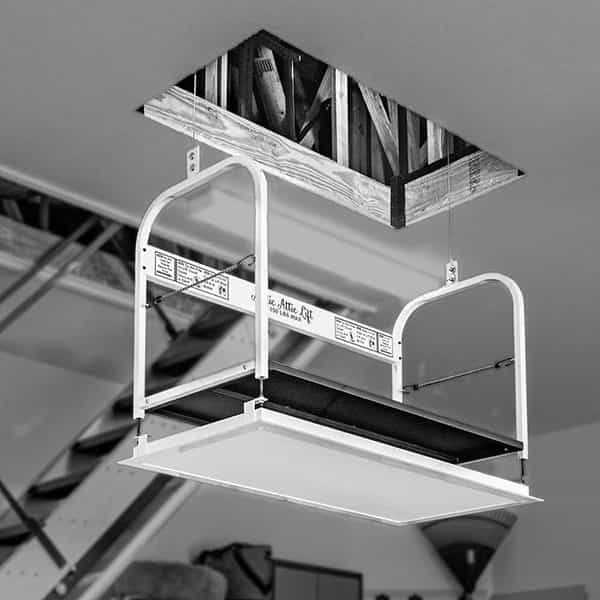
One button brings the unit down without any cord-pulling or balancing acts. You get immediate, reliable access without any heavy lifting. It is operated by a dedicated wall switch or wireless remote on a fully motorized attic lift.
Features
- Folds vertically into the ceiling
- Remote control and wall switch options
- Supports up to 500 lbs
Pros
- Designed for commercial and high-traffic settings
- It’s stable, engineered construction reduces the risk of slips or falls
- Requires fewer repairs, less maintenance, and has a longer lifespan
Cons
- Requires professional installation and electrical setup
Best For: Serious vehicle collectors, accessibility-focused installations, and smart home garage builds.

Tips to Choose Your Ideal Attic Access Solutions
Buying the wrong ladder is a safety and clearance problem rather than just a money issue. A few quick measurements and honest answers about how you use your overhead space will eliminate half the options.
You can easily narrow down your choices with these aspects before you spend a single dollar.
- Frequency of use dictates whether seasonal bin storage demands different hardware than weekly workshop trips.
- Load capacity requires adding your body weight plus the heaviest thing you will carry to avoid dangerous flexing.
- Insulation and energy efficiency are crucial if the attic space sits above a conditioned room.
- Material choices mean wood cuts easily while aluminum resists corrosion.
- Safety features like handrails and non-slip treads are non-negotiable for anything over an 8-foot drop.
|
Ladder Type |
Frequency of Use |
Floor Space Required |
|
Motorized |
Daily |
Minimal |
|
Pull-Down |
Seasonal to Weekly |
Medium |
|
Telescoping |
Monthly |
Minimal |
Wood vs. Aluminum vs. Steel: Which Frame Material Wins
Material choice dictates how long your unit lasts and how easy it is to lift into place. It also determines whether the frame handles the climate inside your garage.
Wood is the lightest on the budget and easiest to trim or modify on-site. It cuts clean, installs fast, and works perfectly well in dry, climate-controlled garages. Wood naturally swells and warps in humid conditions, while repeated use accelerates wear on hardware joints.
Aluminum is the absolute sweet spot for most standard garage builds. It is completely corrosion-resistant, lightweight enough to install solo, and structurally strong enough for household loads.
You get a mid-range cost with massive availability across all major product types.
Steel is built specifically for serious loads and high-frequency, aggressive cycles. It will not flex, wobble, or corrode the way lighter framing materials eventually do.
Heavy-duty workshops demand a robust daily operation from a steel lift.
For most garage builds, choose aluminum. Heavy-duty workshops demand steel. Dry, budget-first installations can easily use wood.
|
Key Insight: While wood is cheaper upfront, aluminum offers the absolute best balance of weight, corrosion resistance, and structural integrity for unconditioned garage environments. |
Is Your Attic Ladder Losing You Money?
An uninsulated hatch can account for massive HVAC loss in conditioned spaces. That is not a small number when you look at your utility bill.
Most basic attic access panels are sold absolutely bare without insulation as a factory default. The moment that a hatch sits above a finished room, you are literally paying to heat and cool the sky. Research shows the entire assembly's R-value can drop by 15 percent due to an uninsulated attic hatch.
- R-value ratings demand an R-10 minimum on hatch covers for standard conditioned spaces. Fire-rated assemblies may require even higher specifications depending on your building's construction type.
- Energy guidelines mandate that drop-down attic stairs produce a continuous air seal when the occupant is not accessing that attic using an insulated cover.
- Weatherstripping is the most overlooked DIY fix, cutting thermal transfer significantly in just a few minutes.
- Knee wall doors are structurally the most thermally efficient option because they seal identically to an exterior home door.
- Given today’s energy prices, especially in older homes, you might find an inadequate level of insulation.
If the space sits above something you heat or cool, factor insulation into your budget from the start. Never treat it as a reactionary afterthought.
|
Warning/Important: An uninsulated attic hatch in a climate-controlled space forces your HVAC system to work overtime. Adding a simple weatherstripping seal and insulated cover pays for itself in just a few months. |
Upgrade Your Attic Access Today
Bad overhead access is a completely solvable problem. Every single option outlined in this guide improves upon balancing on a wobbly chair.
Reclaiming your overhead space should make your shop better without putting you in the hospital.
Explore comprehensive access options today and take advantage of free layout design consultations. We offer financing on higher-end installations so you can build it right the first time.
Enjoy the lowest delivered pricing guarantees alongside free shipping on qualifying orders. Our company also allows a 30-day return window on unopened items to ensure complete satisfaction.


