





Many people with a garage attic know the familiar routine. You stack storage bins at the base of the pull-down stairs, haul them up, and balance precariously while avoiding dropping heavy items on your head.
This process quickly becomes tedious, and beyond the frustration, this storage solution is a physical risk. The core problem is not overhead access alone.
Conventional access requires you to elevate the extra weight by yourself, meaning every annual changeover becomes a hazardous event.
Most customers use whatever is installed or grab a storage solution from the hardware store, even when neither choice is designed to move heavier items without proper safety.
This guide compares choices for loft storage systems, from a ceiling-mounted garage storage rack to an automated attic lift.
We define what heavy means in a functional sense, walk through important safety questions, and show where lift-assisted garage storage outperforms manual setups for loads that make elevated entry dangerous.
Common Garage Attic Storage Options
Not every suspended attic storage lift works for the same job. Before committing to a specific structure, evaluate options across the factors that matter when moving bulky items: lifting effort, overall weight capacity, access speed, and whether the arrangement preserves your valuable floor space.
Frequent annual swaps, heavy toolboxes, and clunky camping gear stress a garage storage rack in a different way than low-mass seasonal decorations that sit untouched.
Here is how the three primary options compare.
|
Storage Option |
Lifting Effort |
Load Capacity (Typical) |
|---|---|---|
|
Pull-Down attic stairs |
High: user carries full load |
275 lbs |
|
Ceiling-Mounted Garage Racks |
High overhead loading required |
200 to 800 lbs (system-dependent) |
|
Motorized Attic Storage Lifts |
Low; ground-level loading |
150 to 1000+ lbs (model-dependent) |
|
Warning/Important: Temporary “just this once” storage can quietly become permanent, introducing structural risks that manufacturer load ratings don’t cover. A proper lift system removes the dangerous part of the workflow entirely, every time. |
Pull-Down Attic Stairs
Pull-down stairs are an improvement over dragging out ladders whenever you need upper entry. For easy small-item retrieval, they do a good job, providing fixed, repeatable entry without consuming garage floor space.
The limitation surfaces the moment the burden gets cumbersome. The stairs provide easy access to the space, but they do nothing about the heavy lifting.
Pull-down stairs suit empty luggage, lightweight holiday decorations, or low-frequency retrieval. They are not the correct tool for auto parts or any load that is hard to carry through a snug opening.
Improving loft access and eliminating the need to carry the extra weight are two distinct problems; stairs address just one.
 |
|
Ceiling-Mounted Garage Storage Rack Systems
Overhead storage is a smart way to clear clutter and reclaim your garage floor. It taps into wasted space that most garages leave unused.
The initial setup requirements dictate everyday usability. Ceiling height, ceiling joist spacing and direction, clearance over parked vehicles, and the vertical travel distance for loading must all be mapped before you commit to a mounting area.
A load-rated garage storage rack installed to standard specifications can handle ample weight, but that load still has to get up there, which requires safe lifting from ladders. The Inventive Garage product line is worth reviewing if you want suspended options built for this specific demand.
For extended, low-rotation storage, these racks perform well. For seasonal items that move more often, the upward loading requirement reintroduces the same hazard as carrying a heavy weight up a set of stairs.
Static racks define where items live. The next step up is a storage solution that removes the manual lifting requirement.
 |
|
Motorized Auxx Attic Lift
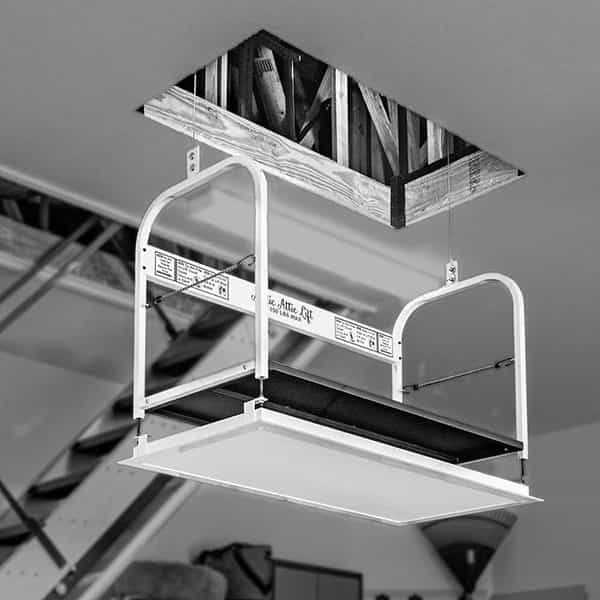
Powered attic lift models change the workflow at the crucial part. You load the platform at ground level, push a button on the wireless remote control, and the unit raises the heavy stuff straight to the attic floor. No carrying weight, no climbing while loaded, and no unbalanced grip through a ceiling opening.
The best applications include items too heavy for manual lifting: Winter gear, replacement parts, archive boxes, filled coolers, and shop supply cases. The lift handles the load well within its rated weight capacity.
The workflow improvement compounds with every periodic changeover. You get fewer high-risk lifts, faster turnaround, and a dependable process that provides peace of mind when managing the load.
These systems demand careful planning, adequate clearance, matching the unit to the intended load type, and professional attention from the start. Options like the Auxx lift or Versa lift offer real benefits but are not basic plug-and-go units.
For spaces with large, rotated inventory, they remain a great solution for the job. Their easy operation makes an attic lift a smart choice over conventional methods.
|
Majic Attic Lift System: Motorized Attic Lift for Garage and Home Storage |
 |
|
What Counts as “Heavy” for Overhead Storage on the Attic Floor?

“Heavy” is not just a number on a bathroom scale. An item manageable on flat ground becomes a hazard when carried higher through a narrow opening or balanced up ladders without a free hand.
A helpful way to categorize storage loads is in three tiers based on real-world examples users recognize:
- Light (under 150 lbs): Small decor bins, unfilled luggage, and low-mass seasonal totes move without much concern on any standard storage setup.
- Moderate (150-200 lbs): Stuffed storage bins, bagged sports gear, and household overflow boxes stay manageable on the garage floor, but steep angles increase the strain.
- Heavy (200 + lbs or any clunky load): Dense tool sets, packed coolers, auto parts, and full camping kits are tough to carry through a tight ceiling area or balance on a storage rack.
Beyond individual item weight, there is the concept of functional weight: an item's difficulty increases when you must lift it above shoulder height or carry it without a spare hand.
At the system level, overall distributed load matters as much as singular item weight. Solid anchoring support, platform size capacity limits, and load distribution across the area determine whether your structure stays secure over decades of use.
Knowing your load type before you plan the initial setup helps avoid a mismatch between what you are storing and what the system is rated to handle. This preparation saves time and ensures safe usage for customers.
|
Key Insight: A 35-pound container that's easy to carry across your garage becomes a 35-pound hazard when you're balancing on stairs with one hand. Functional weight is about position and grip, not just the number on the scale. |
Manage Floor Space with Inventive Garage
For heavy items or frequently used storage boxes, the best system removes manual lifting from the process. Pull-down stairs improve access, but they do not solve the strain of carrying bulky loads overhead.
Mounted garage racks are ideal for static storage, while an automated attic lift makes seasonal changeovers safer and easier.
Inventive Garage helps plan the right setup for your space. Because the team is made up of active makers, recommendations come from hands-on experience rather than a generic product catalog.
Customers can get custom layout guidance based on space photos, practical storage goals, ceiling height, load type, and available depth.
If your current routine involves hoisting heavy totes every season, there is a better way to organize your garage. Measure your ceiling height, access dimensions, and storage depth, then compare your heaviest items against platform size and weight ratings.
Inventive Garage can help you evaluate options such as a Versa Lift or an Auxx lift with remote control and recommend a layout that fits your space.


