





The choice between a cable hoist and a motorized lift gets framed as a price gap — a few dollars of rope and pulley against a few thousand dollars of motor. That framing hides the thing that actually decides it, which is not money at all.
We sell motorized lifting equipment and we do not sell manual hoists, so you should read this knowing which side of that line we are on. What we can tell you is what the specs say, because we pull them for customers every day. Here is the one that reframes the question: a cable hoist tops out around 200 lb and you pull every pound of it by hand. The motorized single-point equivalent lifts 400 lb, up to 20 feet, on a remote — and is tested to UL standards at four times its rated capacity.
Below: what each one genuinely does well, the five things that decide it, and an honest account of when a hoist is the right answer and you should keep your money.
Key Takeaways
| Question | Quick Answer |
|---|---|
| What is a cable hoist? | A rope-and-pulley system that raises a bike, kayak or ladder to the ceiling by hand. Cheap, simple, and rated well below a lift — typically 50 to 200 lb across the category. |
| What does a motorized lift add? | Capacity and repeatability. The single-point motorized equivalent lifts 400 lb to 20 ft on a wireless remote; platform lifts carry 400 to 800 lb; attic lifts go to 2,000 lb. |
| Which is safer? | The motorized route, on models that publish their specs. Look for overload protection and a published stopping method, and confirm them per model rather than per brand. |
| When is a hoist genuinely right? | One or two specific light items, reached a few times a year, by someone comfortable hauling a rope from a ladder. If that's the whole job, buy the hoist. |
| When does a hoist stop making sense? | Past roughly 150 lb, past monthly access, or in any household where the person using it shouldn't be on a ladder. |
| Do you sell cable hoists? | No. We sell the motorized equivalents, from the Auxx-One Universal Lifter up to attic lifts. |
What a Cable Hoist Actually Is
A cable hoist is the oldest idea in garage storage: a rope, a set of pulleys, a pair of hooks and a cleat on the wall. You clip the load, haul the rope hand over hand, and tie it off. Gravity does the lowering, which is the part worth thinking about.
It is genuinely good at one thing — getting a single awkward object off the floor for very little money. A kayak, a canoe, a ladder, a wheelbarrow, a bike. If that is the whole job, a hoist does it, and nothing here is an argument against that.
The limits are structural rather than mechanical. Rated capacity across the category typically runs 50 to 200 lb, and the practical figure is lower, because the rating assumes a balanced load and a clean vertical pull. More to the point, every retrieval costs the same physical effort as the first one, usually from a ladder, usually with one hand committed to the rope.
We do not stock cable hoists, so we will not quote you a price or a brand for one. What follows is a comparison, not a pitch.
What the Motorized Side Actually Looks Like
"Motorized lift" gets treated as one product at one price. It is neither — there are three distinct tiers, and they solve different problems.
Single-point lifters — the direct hoist replacement
This is the like-for-like comparison. The Auxx-One Universal Lifter is $1,589 and does exactly what a rope hoist does, with a motor and a wireless remote instead of your shoulders. Its published figures: 400 lb, up to 20 feet of travel, a multipurpose E-beam with multiple anchor points, and testing to UL standards at four times its rated capacity.
Set that against the category it replaces. A hoist's ceiling is around 200 lb, and there is no test regime behind most of them at all. The motorized version doubles the capacity and removes the effort — but it is a considered purchase, not an impulse one, and we would rather say so plainly.


Platform lifts — when it's a load, not an object
A hoist lifts a thing. A platform lifts a load, and stays below the ceiling. The ONRAX Ascension starts at $1,570 for the 3' × 4' with a key-lock wall switch, or $1,780 with a wireless remote; it carries 400 lb and suits ceilings up to 14 feet. The Auxx-Lift Storage Platform Lift runs from $2,389 in 400 lb and 600 lb ratings. At the top, the Cloud Lift is $3,615, carries 800 lb, reaches 20-foot ceilings, and is built in Texas.


Attic lifts — when the load goes through the ceiling
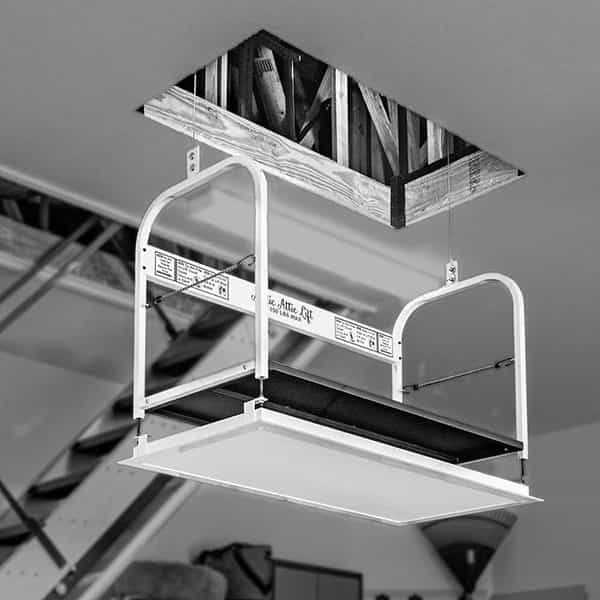
Only here does the storage leave the room. An attic lift raises a platform through an opening into the attic above, which converts the whole attic floor into storage instead of the band under your ceiling. The lineup runs 150 lb to 2,000 lb: the SpaceLift at $1,895, the Auxx-Lift Attic-Lift in the middle at 400 lb with 12 ft or 18 ft of travel, and the custom cargo lifts at the top.

The comparison most articles get wrong
The hoist-versus-lift decision is usually presented as a budget question. It isn't. A hoist and a motorized lifter do not have the same ceiling: 200 lb against 400 lb, untested rope against UL-standard testing at 4× rated capacity, and effort that recurs against effort you spend once. Decide on the load and the frequency first. The price follows from that answer, not the other way round.
Motorized Lift vs Cable Hoist: The Head-to-Head
| Criterion | Cable Hoist | Motorized Lift |
|---|---|---|
| Rated capacity | Typically 50–200 lb across the category | 400 lb single-point; 400–800 lb platform; to 2,000 lb attic |
| Effort per use | Full physical effort, every time, usually from a ladder | One button, standing on the floor |
| Entry price | The cheapest overhead option there is | $1,570 for a platform lift; $1,589 single-point; $1,895 to reach the attic |
| Where the load ends up | Hanging below the ceiling, still in the room | Below the ceiling, or through it onto the attic floor |
| Overload behaviour | None — the rope holds until it doesn't | Published overload protection on most models; confirm per model |
| Stopping | You judge the height and tie off | Factory-set travel limits; emergency stop published across our attic lift lineup |
| Installation | Homeowner, into joists | Platform lifts into joists and an outlet; attic lifts need an opening, framing and power |
| Best for | One or two light bulky items, rarely accessed | Anything heavy, anything frequent, anyone who shouldn't be on a ladder |
The Five Things That Actually Decide It
1. The real weight, not the optimistic one
Weigh the heaviest thing you intend to lift, then add what it will weigh in two years once the bin has grown. A hoist rated 150 lb and a load that creeps to 160 is not a small problem: nothing in the system tells you that you have crossed the line.
Whichever route you take, don't load any overhead system past 80% of its rating. On a motorized unit with overload protection the motor enforces a version of that for you. On a rope, nothing does.
2. How often you reach for it
This is the single biggest differentiator and the one buyers weigh least. A kayak you take out twice a summer is a hoist job. Tools, seasonal stock, or anything on a monthly cycle is not — the effort compounds, and in practice people stop retrieving things rather than face the rope again.
3. Your ceiling, and what is above it
Hoists, single-point lifters and platform lifts need solid framing and headroom, and the platform lifts have real ceiling ranges to check — the ONRAX Ascension suits ceilings up to 14 feet, the Cloud Lift up to 20.
An attic lift is a different question, because the load passes through the ceiling: the Auxx-Lift needs an opening of 22.5" × 46.5" for the Standard platform or 30.5" × 58.5" for the MAX, similar in principle to a pull-down attic ladder's, and it adjusts to your attic floor framing. If there is no usable attic above your garage, that tier is off the table regardless of budget and the real comparison is hoist against lifter.
4. What the safety spec actually says
Be specific here, because the category advertises loosely. Across our nine attic lifts, every one publishes an emergency stop. Overload protection is published on six — the Auxx-Lift, Majic, SpaceLift, Empire, MiTee and custom cargo lifts. Obstacle detection, the sensor that halts the platform if something is in the way, is published on two: the Majic and the SpaceLift.
That is the kind of detail to ask for by model rather than assume from a brand. Ask us and we'll confirm in writing what is built into the specific unit you're considering. Before you install anything, read the overhead storage safety guidelines.
5. Who is installing it
Both routes must bolt into structural ceiling joists or truss chords — never drywall alone, never a plate fixed to furring. A hoist or a platform lift is within reach of a confident homeowner with a stud finder, a socket set and an outlet. Attic lifts involve a ceiling opening, framing and an electrical connection, and most customers hire that part out.
When a Hoist Is Genuinely the Right Answer
We would rather you bought nothing from us than the wrong thing, so here is the honest version.
- You have one or two specific bulky items — a kayak, a ladder, a roof box — and no wider storage problem.
- Those items are comfortably under 150 lb.
- You reach them a handful of times a year at most.
- Someone in the household is comfortable on a ladder, hauling a rope, with one hand committed.
- Budget is the binding constraint and nothing else is close.
If all five are true, buy the hoist. You do not need a motor, and we are not the right supplier for you on this one.
When the Motorized Route Wins
- The load is over about 150 lb. You are at the edge of the hoist category with no margin left.
- You reach it monthly or more. The effort is the real cost, and it recurs for as long as you own the thing.
- It's a load, not an object. A hoist handles one item; a platform handles everything you put on it.
- Anyone in the household shouldn't be on a ladder. Seniors, limited mobility, balance or joint problems — the platform comes down to waist height and you load it standing on the floor.
- There is usable attic space above the garage. The highest-return case: you gain the attic floor rather than the band under the ceiling.
- You are planning to age in place. A system that still works in fifteen years is a different purchase from one that works while your knees do.
Buying From Inventive Garage
- Free expert advice from a mechanical engineer. Send a photo of your ceiling and tell us what you need to lift, and we'll tell you which tier you actually need — including when that answer is "a hoist, and not from us."
- Price match guarantee. We'll match or beat any authorized retailer's advertised price. Ask before you order.
- Shipping. What you pay depends on the product — some items ship free within the contiguous US, while others move by truck. Your cart shows the exact cost before checkout. See our shipping policy for details.
- Installation help. Most customers hire a local handyman or contractor, and we give your installer free technical support. If you'd rather not search yourself, submit your project through our installation request page and Install Genie, an independent installation-coordination service, will connect you with insured independent installers. Full factory-crew installation is available in Texas and southern Oklahoma through The Attic Lift Installation Service — $575 to $2,040 depending on scope, plus travel.
- 30-day returns. Returns accepted within 30 days of receipt. Return shipping is the customer's cost and a restocking fee of up to 20% may apply depending on the supplier, so talk to us before you buy if you're unsure — it's cheaper than sending it back.
Conclusion
A cable hoist and a motorized lift are not competing for the same job, and the price gap everyone quotes is measuring the wrong thing. A hoist is a one-item, low-frequency tool, and within those limits it is a good one. The moment you have a storage problem rather than a single awkward object, it cannot scale — not in capacity, not in effort, and not for anyone who shouldn't be climbing to reach it.
The motorized side answers that at three different heights: a single-point lifter at 400 lb, a platform lift that carries a whole load below the ceiling, and an attic lift that puts the load through the ceiling and gives you the attic floor. Work out which problem you have, and the tier picks itself.
Not sure which one describes your garage? Browse the attic lift collection, or call or text us at 800-948-7780 with a photo of your ceiling and we'll tell you straight.
Frequently Asked Questions
Is a motorized lift worth it over a cable hoist?
It depends on weight and frequency, not on budget alone. For one light item reached twice a year, a hoist is fine and we'll say so. Past roughly 150 lb, or past monthly access, the motorized route wins on capacity, on effort and on safety — the single-point motorized equivalent carries 400 lb against a hoist's typical 200 lb ceiling, and is tested to UL standards at four times its rating.
How much weight can a cable hoist hold?
Rated capacity across the category typically runs 50 to 200 lb, and the practical figure is lower because the rating assumes a balanced load and a clean vertical pull. We don't stock hoists, so treat that as a category range and check the rating on the specific product you're looking at.
How much weight can a motorized lift hold?
Considerably more, across a wide range. The Auxx-One single-point lifter is rated 400 lb to 20 feet; platform lifts run 400 lb on the ONRAX Ascension up to 800 lb on the Cloud Lift; attic lifts run from 150 lb on the Majic to 2,000 lb on the MiTee post-style and custom cargo configurations. Match the rating to your heaviest realistic load and stay under 80% of it.
Do cable hoists and motorized lifts mount the same way?
Both must bolt into structural ceiling joists or truss chords — never drywall alone. Beyond that they differ: a hoist, a single-point lifter or a platform lift needs solid framing, headroom and, for the motorized ones, an outlet. An attic lift also needs a ceiling opening and framing around it.
Can I install a motorized lift myself?
Single-point and platform lifts are within reach of a confident homeowner — a stud finder, a socket set and a nearby outlet. Attic lifts are a bigger job because of the ceiling opening and the electrical connection; most customers hire a contractor, and we support whoever they hire at no charge.
What safety features should I look for?
Overload protection and a published stopping method matter most, plus obstacle detection if the lift runs where people or pets move. Confirm them per model rather than per brand — across our attic lift lineup all nine publish an emergency stop, six publish overload protection, and two publish obstacle detection. Ask us and we'll confirm in writing for the model you're considering.
Do you sell cable hoists?
No. We sell motorized lifting equipment — the Auxx-One Universal Lifter, platform lifts like the ONRAX Ascension, and attic lifts. If a hoist is genuinely the right answer for your situation, we'll tell you so.

About the author: Victor Urbach is a mechanical engineer and ASME member who founded Inventive Garage & Workshop in 1997. He advises customers and contractors on lift selection, ceiling framing and heavy-payload installations. Read Victor's full bio.


